
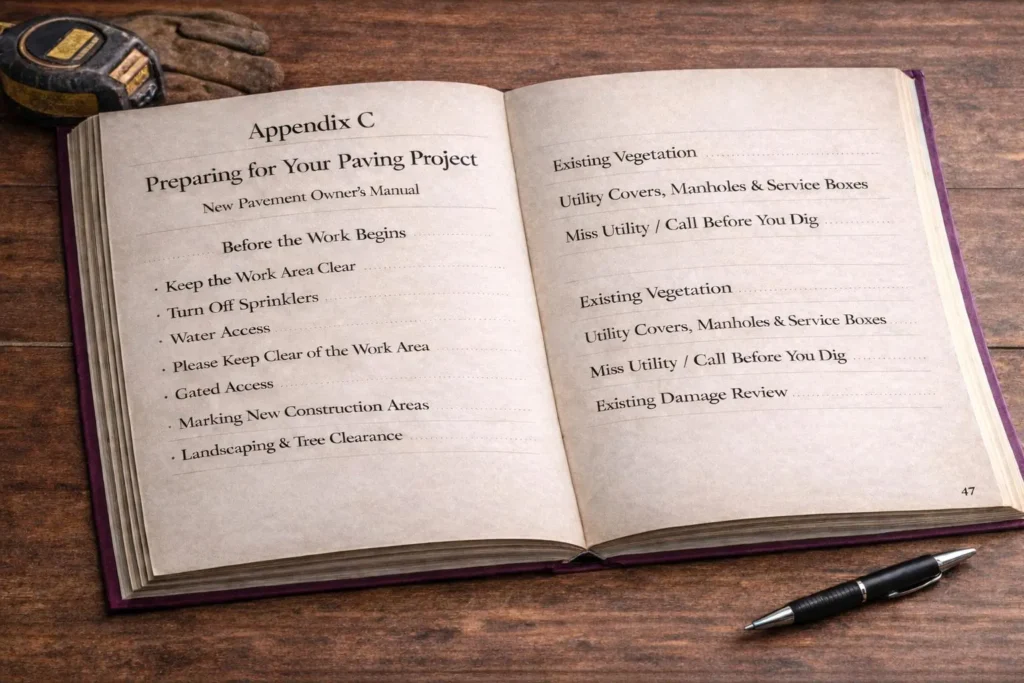
PREPARING FOR YOUR PAVING PROJECT
Before the Work Begins.
To help your paving project stay on schedule and proceed without unnecessary delays, please review and address the items below before our crew arrives. Proper preparation allows us to begin work promptly and complete your project as planned.
KEEP THE WORK AREA CLEAR
The work area must be fully cleared and accessible on scheduled work days. This ensures our crew can operate equipment safely and efficiently and deliver the highest quality finished surface.
Before we arrive, please remove all vehicles, trailers, dumpsters, portable basketball hoops, planters, and any other items from the area to be paved.
If you need assistance moving an item, let us know ahead of time and our crew will be happy to help where possible.
During scheduled work days, the paved area must remain clear and accessible for our crew only.
Please make sure that:
- No other contractors or service providers are scheduled if they require access to the area being paved
- No deliveries of any kind are planned, including package, appliance, or material deliveries
- No vehicle traffic passes through the work area during construction
For private roads and pipe stems, please cancel garbage pickup for all paving days and for at least three days after installation. Garbage trucks are extremely heavy and do not operate like typical passenger vehicles. They frequently stop, back up, turn sharply, and concentrate significant weight in small areas while loading, which can damage new pavement if allowed on it too soon after installation.
Turn Off Sprinklers
All sprinklers must be turned off before and during paving. Water contacting hot asphalt or tar & chip materials can interfere with proper installation.
While not required, clearly marking any sprinkler heads, valve boxes, or shallow irrigation lines located near the area being paved is strongly recommended to help reduce the risk of accidental damage during paving operations.
Water Access
- 5–10 gallons for smaller, partial-day jobs
- 50–60 gallons for larger, full-day projects
Please Keep Clear of the Work Area
For everyone’s safety, we ask that people and pets stay at least 20 feet away from the work area at all times.
Active paving operations involve moving machinery, dump trucks, hand tools, and crews working in close coordination. Job sites can be loud, visibility can be limited, and equipment and vehicles may move unexpectedly. Our crews are trained to understand where it is safe to stand and how to work around these conditions. When untrained individuals enter the work area, those same conditions can create unnecessary risk, and accidents can happen.
Gated Access
If access to the job site is gated:
- For private gates on your property, please provide the access code or leave the gate open on the day of work
- For gated communities, please notify gate security in advance or provide the necessary access information so our crews can enter without delay
Marking New Construction Areas
For projects that include new construction—such as widening, lengthening, or adding parking areas—we typically include sketches, measurements, or written notes in the proposal to help define the intended layout. To help ensure the work is completed the way you want it done, please clearly mark the perimeter edges of the new construction using spray paint, flags, or stakes prior to our arrival. All markings should correspond to the approved square footage of new construction outlined in your proposal.
If markings are not provided, our crew will make every reasonable effort to interpret the layout and complete the work in a way we believe reflects how the customer intended the area to be designed, based on the information available and existing site conditions. However, without clear markings in place, we cannot guarantee that the final layout will match what was originally envisioned.
Providing clear, accurate markings in advance helps ensure the area is constructed the way you envisioned and planned.
Landscaping & Tree Clearance
Please trim back any overhanging bushes, plants, or landscaping beyond the pavement edge so our equipment has adequate working clearance.
Please also trim or pull back any low or overhanging tree branches to provide sufficient overhead clearance for paving equipment and trucks.
Existing vegetation
Before paving begins, every reasonable step should be taken to kill out existing grass, weeds, roots, and other organic material. We take vegetation control seriously and do everything within our power during site preparation to address it properly. As part of our normal process, we remove or burn out visible vegetation, clean the area, clear the surface, and thoroughly apply a quality herbicide to kill out vegetation and help prevent regrowth. This represents the maximum practical level of vegetation treatment that can be performed during normal paving operations.
That said, even with proper removal or burning out and herbicide application, vegetation often requires time to fully die off. Because paving work typically follows shortly after site preparation, there is not always enough time for herbicide applied on the day of installation to fully take effect. In addition, paving directly over treated areas—particularly with hot asphalt—can reduce the herbicide’s ability to continue working after installation. This is a limitation of timing, not effort.
For this reason, vegetation should be killed out with herbicide by the property owner in advance of our arrival (of course, we will still follow our normal vegetation removal and treatment procedures as part of site preparation). This is usually a simple and inexpensive step for property owners, and in many cases it is something they already do as part of routine property or landscape maintenance. Many property owners already have vegetation killer on hand that can be applied ahead of time. If not, vegetation killers are readily available at home improvement stores, garden centers, or can be easily ordered online and delivered directly to your door. This is typically light work—often just spraying the vegetation—and can usually be completed in a short amount of time. Many property owners also have a lawn care service that can handle this if preferred.
When vegetation is not fully killed out prior to paving, it can, in some cases, grow through the new pavement—most commonly within the first year, before the surface has fully cured and hardened. This can occur even on the highest-quality paving installations, where all work is performed correctly and to industry standards, and is not an indication of improper installation or poor workmanship. Addressing vegetation ahead of time greatly reduces the likelihood of regrowth and helps ensure the best possible outcome.
Utility Covers, Manholes & Service Boxes
Some driveways, private roads, and pipe stems contain utility covers, such as water meter lids, sewer cleanouts, manholes, or other utility access covers located within or adjacent to the pavement.
If you want any of these covers raised, lowered, or adjusted to match the final pavement height, this must be coordinated in advance by the property owner.
Utility covers can only be adjusted by the utility owner or the appropriate utility authority (such as the water, sewer, or utility company). We are not permitted to modify or adjust utility-owned infrastructure.
If no adjustment is arranged ahead of time, the new pavement will be neatly tapered to the existing cover elevation.
If you are unsure who owns a particular utility cover, contacting your local utility provider or county utility authority is the best place to start.
Miss Utility / Call Before You Dig
If your project involves machine excavation into native soil, you must contact Miss Utility / Virginia 811 before work begins. For clarity, excavation means digging into soil using powered equipment such as excavators or skid steers.
Excavation does NOT include:
- Removing or excavating existing asphalt
- Performing base work or adding stone base
- Minor excavation performed by hand, such as widening, lengthening, or reshaping edges
Miss Utility is required only when machine excavation into soil is involved. This free service marks the approximate locations of underground utility lines and is required by law when machine excavation is performed.
To request utility markings:
- Dial: 811
- Or call: 1-800-552-7001
Requests must be made at least three working days before excavation, and all markings must be completed before our arrival when machine excavation is part of the project.
Existing Damage Review
Before work begins, we strongly recommend taking a few minutes to walk the work area and inspect anything that directly touches or borders the pavement.
This includes:
- Concrete garage floors and garage door thresholds
- Concrete aprons, sidewalks, curbing, and slabs adjacent to the pavement
- Landscape edging, borders, and hardscape that meet the pavement edge
When a new driveway or road is installed, people naturally start looking at areas they may not have closely examined before. Reviewing these areas ahead of time helps distinguish pre-existing cracks, chips, or damage from the new pavement work and avoids confusion later.
If you notice any existing damage or have questions about adjacent surfaces, please let us know before work begins so it can be reviewed in advance.
READY TO GET STARTED ON YOUR PAVING PROJECT?
Contact Standard Paving for a professional site evaluation and a free, written estimate.
WANT TO KEEP LEARNING ABOUT THIS TOPIC?
Return to the TOPIC PAGE to continue exploring related information.

WANT TO EXPLORE A DIFFERENT TOPIC?
Return to the HOME PAGE to browse other topics and find the information you’re looking for.
WOULD YOU RATHER TALK TO A TEAM MEMBER DIRECTLY?
If you need further assistance or would like a free estimate and prefer to speak with someone in person, give us a call.